
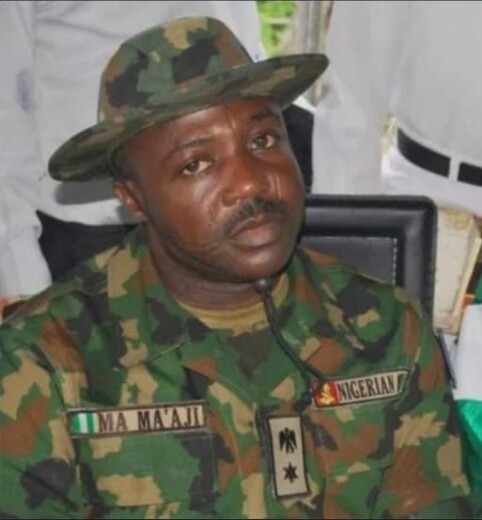

Mohammed Ma’aji, a Nigerian military colonel, has been reported to be the face behind the foiled coup aimed at toppling President Bola Tinubu’s government.
Recall that the Defence Headquarters announced the arrest of 16 officers for acts of indiscipline and breaches of service regulations, following weeks of quiet tension within the Armed Forces.
Although authorities earlier denied the report, the Defence Headquarters admitted on Monday, January 26 that about sixteen military officers plotted to overthrow the current administration.
About the prime suspect;
Colonel Ma’aji was a security adviser to Timi Sylva in the 2015 Bayelsa State gubernatorial election.
Ma’aji was born in 1976 to Nupe parents, in Niger State.
He was a member of regular course 47 of the Nigerian Defence Academy, NDA.
Ma’aji served as Commanding Officer, CO of the 19 Battalion in Okitipupa, Ondo State, before he was posted to Koko, headquarters of Warri North LGA, Delta State, in 2017.
Colonel M. A. Ma’aji was number one in the list of 16 indicted officers released on Monday by the panel set up to investigate the matter.
This confirmed earlier reports indicating that Ma’aji led the failed coup.
The rumours, the emerging facts
In October 2025, rumours of an alleged coup plot against President Tinubu’s administration spread across social media. At the time, the Defence Headquarters (DHQ) dismissed the claims as “false and misleading,” even as the sudden cancellation of the Independence Day parade fuelled speculation about deeper security concerns.
However, fresh findings from an interim investigation report, sighted by Punch Newspapers, suggest that the alleged architect of the plot was a Colonel whose repeated failures in promotion examinations reportedly bred resentment and alienation. Rather than nursing his grievances quietly, he is said to have turned them into a recruitment tool, drawing officers from the Army, Navy and Air Force into a loose but coordinated network.
According to the report, members of the group were allegedly assigned to discreetly study sensitive installations, including the Presidential Villa, the Armed Forces Complex, Niger Barracks in Abuja and international airports in Abuja and Lagos, mapping access routes, routines and vulnerabilities. What began as expressions of dissatisfaction soon graduated into early-stage operational planning.
Security sources say searches on the officer’s vehicle uncovered charms and anti-government materials, while a raid on his residence in Lokogoma, Apo, yielded sensitive documents detailing assigned roles and outlining how key national dignitaries were to be handled once the operation commenced.
Security sources say searches on the officer’s vehicle uncovered charms and anti-government materials, while a raid on his residence in Lokogoma, Apo, yielded sensitive documents detailing assigned roles and outlining how key national dignitaries were to be handled once the operation commenced.
The plotters are also said to have exploited insider access, infiltrating the Presidential Villa and compromising workers linked to construction firm Julius Berger to obtain security information on the premises. Encrypted communication platforms were allegedly used to coordinate movements, logistics and funding, while discreet vehicle repairs and unusual cash flows pointed to preparations for mobilisation.
Investigators traced financial inducements of between N2 million and N5 million to some principal actors, with intelligence agencies now analysing the money trail through the Nigerian Financial Intelligence Unit.
One of the suspects, Lt-Col S. Bappah, reportedly turned a critical witness, admitting his role and providing details on recruitment methods, funding channels and communication patterns within the network.
The danger, security officials note, lay in the cross-service reach of the conspiracy, which cut across the Army, Navy and Air Force and involved officers up to the rank of Brigadier-General.