
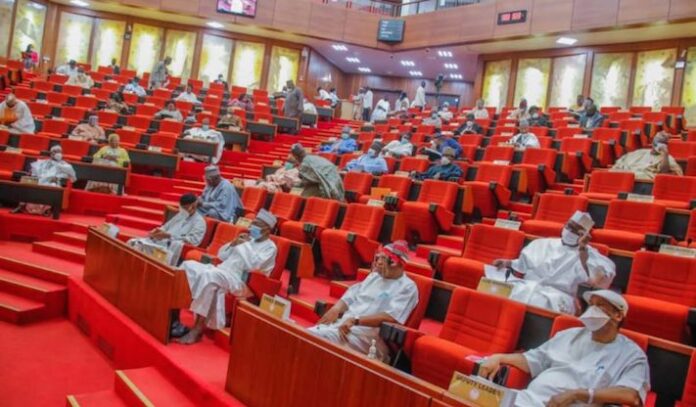

The Nigerian Senate has swiftly approved President Bola Tinubu’s request to secure $6 billion in external loans, with the approval coming just three and a half hours after the proposal was presented. The loans are intended to support budget implementation, infrastructure development, and debt repayment.
The approved loans include a $5 billion structured total return swap (TRS) external financing programme with First Abu Dhabi Bank of the United Arab Emirates and a $1 billion UK export finance loan facility arranged by Citibank, London branch, for the rehabilitation of Lagos Port Complex and Tin Can Island Port.
Nigeria’s total public debt currently stands at $110.3 billion, equivalent to about N159.2 trillion as of December 31, 2025. The government plans to draw the loan in phases to reduce pressure on the country’s debt stock and servicing obligations.
How it was hurriedly approved
The approval on Tuesday came barely three and half hours after the President of the Senate, Senator Godswill Akpabio read the letter from the President, seeking for the approval.
The letter was read the first time, scaled second ready and was read the third time and passed same day by the Senators.
The Senate approved the loans following the presentation and consideration of the report by Senator Aliyu Wammakko, APC, Sokoto North, Chairman, Senate Committee on Local and Foreign Debts.
Earlier, President Tinubu’s request to borrow was contained in two separate letters addressed to the President of the Senate, Senator Godswill Akpabio that were read during plenary on Tuesday.
According to the President, the Senate should “Pursuant to Sections 21(1) and 27(1) of the Debt Management Office (Establishment, Etc.) Act, 2003, to: Approve the establishment of a structured Total Return Swap (TRS) derivative external financing programme of up to USD5.00 billion with First Abu Dhabi Bank (FAB), United Arab Emirates; ” Approve the indicative Terms and Conditions of the facility, including collateralisation with Naira-denominated Federal Government of Nigeria (FGN) Securities and margining obligations in USD; and Authorize the Federal Government to draw down the facility in tranches and issue FGN Securities as collateral.”
In first letter read by Akpabio President Tinubu requested for the approval to establish a structured total return swap (TRS) external financing programme of up to $5 billion with First Abu Dhabi Bank of the United Arab Emirates.
In the letter, President Tinubu who noted that the facility would be made available to Nigeria in tranches, said, “The purpose of this letter is to request for the approval and resolution of the national assembly pursuant to the provisions of section 21(1) and 27(1) of the debt management office establishment act 2003 to establish a structured total return swap (TRS) derivative external financing programme from First Abu Dhabi Bank of the United Arab Emirates of up to $5 billion which will be made available to the Federal Republic of Nigeria in tranches.”
According to Tinubu, the proceeds would be used for budget implementation, development of priority infrastructure projects and repayment of relatively expensive domestic and external debts, adding that the facility would also help the federal government meet urgent financial obligations when necessary.
The President said that Nigeria’s total public debt currently stands at $110.3 billion, equivalent to about N159.2 trillion as of December 31, 2025.
According to him, the loan would be drawn in phases to reduce pressure on the country’s debt stock and servicing obligations.
In the second letter, Tinubu also asked the Senate to approve the issuance of naira-denominated federal government securities as collateral for the facility and the payment of margining obligations in US dollars.
In the letter, the President who sought approval for a $1 billion UK export finance loan facility arranged by Citibank, London branch, said that the loan would be used for the reconstruction and rehabilitation of the Lagos Port Complex and Tin Can Island Port.
The letter read, “The rehabilitation of the ports project is a strategic modernisation initiative of the Federal Government of Nigeria through the Nigerian Ports Authority to restore and upgrade two of Nigeria’s most vital ports namely Tin Can Island Port complex and Lagos Port complex Apapa which have reached critical engineering failures.”
According to him, the project is aimed at addressing infrastructure deficiencies, improve port efficiency, enhance safety standards and align Nigeria’s port facilities with global best practices.
Tinubu added that the rehabilitation would help sustain Nigeria’s competitiveness as a maritime hub and support non-oil trade diversification.
Akpabio subsequently referred the requests to the Senator Aliyu Wammakko, APC, Sokoto North led Senate Committee on Local and Foreign Debts to carry out legislative actions on the request and report back immediately.
In his presentation, Senator Wammakko said, “The proposed financing is structured as a Total Return Swap (TRS), a derivative-based instrument governed by International Swaps and Derivatives Association (ISDA) rules.
” The facility provides access to up to USD5.00 billion, to be drawn in tranches, thereby allowing flexibility in utilization and limiting immediate fiscal pressure. The transaction is collateralised by Naira-denominated FGN Securities at 133.3%, representing over-collateralisation to mitigate lender risk. The securities will be marked-to-market monthly, and any shortfall will require margin calls in USD cash, while excess collateral will be returned to the FGN.
“The facility has a tenor of six (6) years with a three-year break clause and annual rollover provisions subject to mutual agreement.
“The indicative pricing of the facility is SOFR +3.95% for the first tranche and SOFR + 4% for subsequent tranches, which is considered competitive relative to prevailing Eurobond yields for Nigeria. N arranger fee of 1.5% flat per tranche is payable upfront.
“The Committee notes that the pricing reflects Nigeria’s current sovereign risk profile and compares favourably with alternative external borrowing options.”
On use of Proceeds, the Committee said, “The proceeds of the facility are intended for: Budget implementation Financing critical infrastructure projects Refinancing more expensive domestic and external debt, Addressing urgent fiscal and liquidity needs
“In addition, 40% of the said fund will be used to fund the capital projects in 2025 and 2026 budget. The Committee notes that these uses are consistent with national development priorities and fiscal consolidation objectives.”
On Impact on Public Debt and sustainability, Wammakko said, “The facility will be reflected in Nigeria’s extemal debt stock as it is drawn, thereby increasing total public debt.
“As at December 31, 2025, Nigeria’s total public debt stood at approximately USD103.20 billion (N146.69 trillion). The Committee observes that Nigeria’s Debt-to-GDP ratio of 36.92% remains within: the 60% threshold approved by the Federal Executive Council; and The 80% benchmark advised by international financial institutions.
“The phased drawdown structure helps to moderate the impact on debt stock and debt service obligations.
“Debt service-to-revenue ratio remains a concern (estimated at about 60%), underscoring the need for prudent debt management and enhanced revenue mobilization, this we believe should improve as revenues of government improves with the new tax reforms. Strategic and Structural Advantages of the TRS
“The Committee notes several advantages of the proposed TRS structure: Immediate access to foreign currency liquidity without issuing new Eurobonds, thereby avoiding additional pressure on international capital markets.
” Flexible drawdown in tranches, enabling efficient cash flow management and reduced exposure.
“Strengthening bilateral financial relations with a major Gulf financial institution, enhancing Nigeria’s global financing options. Potential refinancing of expensive debt, thereby improving the overall cost profile of public debt.
“Embedded dispute resolution and valuation safeguards, which provide protection to the FGN in the execution of the transaction. Risks and Mitigating Factors. Currency Risk: Margin calls in USD may arise due to exchange rate volatility, Mitigation: Conservative collateralisation and phased drawdownsP