
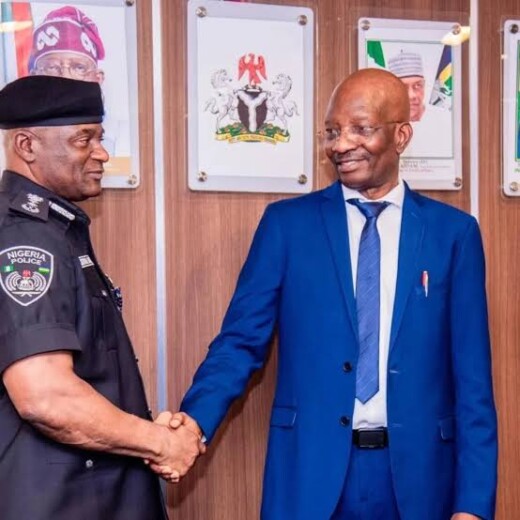

As the former IGP, Olukayode Egbetokun, bids farewell to the force after 36 years of service, with a legacy of strengthened institutional processes and improved security measures, he said Leadership of the Nigeria Police Force is never the story of one individual, but the unfolding story of an institution in constant service to the nation.
Egbetokun’s emotional valedictory address in Abuja marked a bittersweet moment, as he reflected on over three decades of policing and public service. The occasion was a testament to his dedication, with the federal government approving academic and professional programs for police colleges nationwide.
In his parting words, Egbetokun expressed gratitude to President Bola Ahmed Tinubu for the opportunity to lead the force, highlighting the administration’s focus on enhancing operational capacity and responding to evolving security challenges.
Egbetokun disclosed that during his tenure, reforms were implemented to reinforce professionalism, promote merit-based advancement, and strengthen intelligence-led policing within the force.
According to him, the Police Intelligence Bureau was expanded and upgraded into a full department headed by a Deputy Inspector-General of Police, while the legal and medical units were elevated to directorate status to enhance efficiency and service delivery.
The former IGP also highlighted improvements in technological capacity, noting that the police cybercrime centre was transformed into a more advanced facility capable of monitoring Nigeria’s cyberspace and supporting modern investigations.
He added that the national criminal database was strengthened while officers across commands received professional training to boost investigative and operational capabilities.
Furthermore, he said operational presence of the police, was expanded through the establishment of additional Police Mobile Force Squadrons, alongside the creation of new area commands and divisions aimed at bringing policing closer to communities.
Egbetokun also pointed to the establishment of the Special Intervention Squad, which he said had recorded notable operational successes nationwide.
On partnerships, he said the force strengthened collaboration with international partners, opening new opportunities for officers through scholarships and specialized training programmes in countries including the United States, the United Kingdom, China, Egypt, Germany and the United Arab Emirates.
He also highlighted infrastructural development within the force, including the completion and redevelopment of projects in Kano and Kaduna states, ongoing projects in Lagos, and the commissioning of modern police headquarters complexes in Ogun and Adamawa states.
Among other milestones achieved during his tenure, Egbetokun noted the federal government’s recognition of April 7 as National Police Day in honour of police officers and the passage of the Police Institutions and Establishments Act, which provides direct funding for police training institutions.
The former IGP thanked officers and men of the force for their loyalty, courage and dedication to national service even as he appreciated the Minister of Police Affairs, the National Assembly, sister security agencies and international partners for their cooperation.
Egbetokun reserved special gratitude for his family for their patience and support throughout his career, acknowledging the sacrifices through years of police service.
He also formally handed over leadership of the force to his successor, the 23rd Indigenous Inspector-General of Police, Olatunji Rilwan Disu urging him to lead the institution to greater heights.
“As I leave today, I do so with immense pride in the Nigeria Police Force and with full confidence that this great institution will continue to grow stronger in its commitment to protecting the Nigerian people,” he said.
The event attracted a distinguished gathering of senior government officials, retired Inspectors-General of Police, including Mike Okiro and Ogbonna Onovo, members of the National Assembly, service chiefs, heads of sister security agencies, traditional rulers, as well as serving and retired police officers and members of the press.