

President Bola Ahmed Tinubu on Friday assured Nigerians that the current administration remains committed to far-reaching reforms and long-term national development, saying the government’s agenda reflects the visionary and courageous leadership style associated with late nationalist, Obafemi Awolowo.
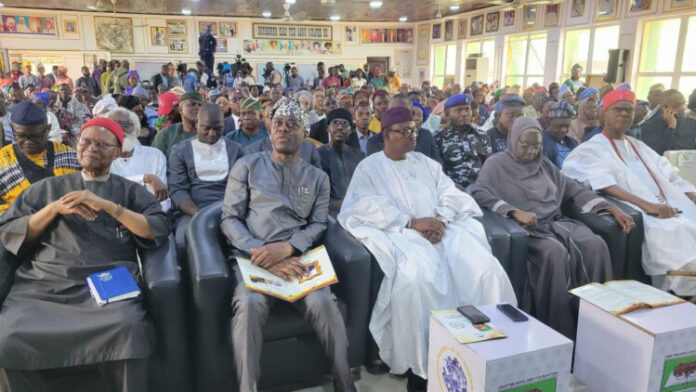
Tinubu stated this in his address at the 2026 Obafemi Awolowo Memorial Lecture, organised by the Obafemi Awolowo Foundation, held at Efunyela Hall, Ikenne-Remo, Ogun State.
The President, who was represented by the Minister of State for Health and Social Welfare, Iziaq Salako, said Nigeria today has a leader in Awolowo’s mould guiding the country through a period of critical reforms.
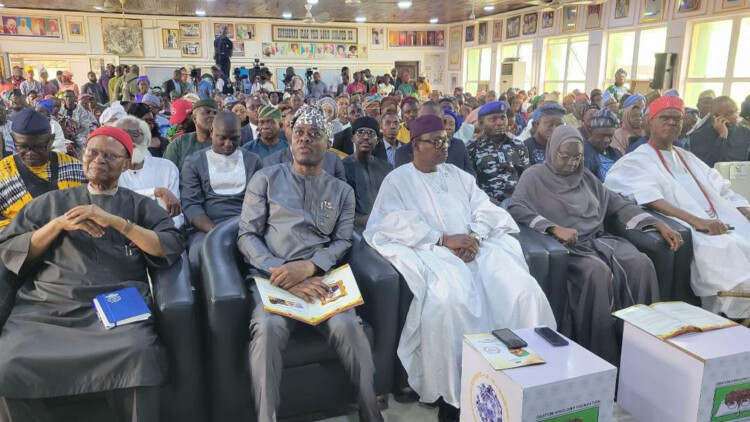
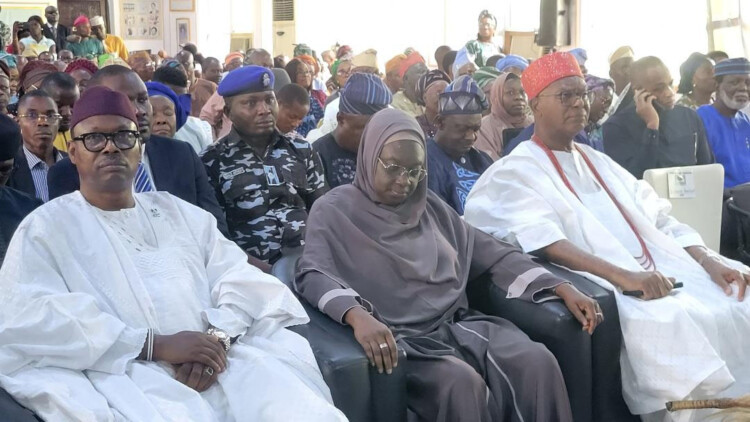
The annual lecture had as its theme, “Politics as Future-Making: Awolowo and Leadership as Theory of Action”, was attended by Ogun State Governor, Dapo Abiodun, represented by his Deputy, Noimot Salako-Oyedele, Oyo State Governor, Seyi Makinde, Obi of Onitsha, Igwe Nnaemeka Achebe, Ladi Adebutu, Senator Femi Okurounmu, Chief Ayo Opadokun, Aare Gani Adams, Dr. Ayo Farounbi, Chief Olabode George, Prince Olagunsoye Oyinlola, traditional and religious leaders.
READ ALSO:Tinubu vows total victory over terrorists, boosts troops’ morale at Iftar
First lady, Oluremi Tinubu opens up on faith, love, shares lessons from 40-yr marriage
30 banks scale recapitalisation hurdle — CBN
Salako described Awolowo as a rare statesman whose courage, intellectual depth and commitment to welfare-oriented governance transformed the old Western Region and left a legacy that continues to shape development in the South-West.
According to him, Awolowo’s tenure as Premier between 1954 and 1959 established the Western Region as a model of development through policies centred on education, healthcare and infrastructure.
“Pa Awolowo was a profoundly wise leader whose ideas and actions placed him among the great thinkers and reformers in history,” he said.
He noted that Awolowo’s introduction of free universal primary education in 1955, despite opposition from colonial authorities and scepticism from some sections of society, remains one of the most consequential policy decisions in Nigeria’s history.
According to him, the policy laid the foundation for the strong human capital base that continues to drive development in the South-West.
He also highlighted Awolowo’s infrastructural revolution, noting that the administration constructed more than 2,000 kilometres of roads across the Western Region, far exceeding the road network inherited from the colonial government.
He noted that his administration’s economic and structural reforms policies had begun to stabilise the economy and improve key indicators.
According to him, Nigeria recorded a Gross Domestic Product growth rate of 4.23 per cent in the second quarter of 2025, alongside improved foreign reserves and a significant reduction in debt-service-to-revenue ratio.
“Nigeria has turned the corner,” he said, urging citizens to support the ongoing reform agenda in order to sustain economic recovery and growth.
In his remarks, former Secretary-General of the Commonwealth of Nations, Emeka Anyaoku, described Awolowo as one of the three founding fathers of modern Nigeria and a leader whose legacy continues to shape national discourse.
Anyaoku said Awolowo’s record as Premier of the Western Region, opposition leader in the First Republic and Vice-Chairman of the Federal Executive Council during the military era earned him the reputation as “the best President Nigeria never had.”
Reflecting on Nigeria’s current political climate, he cautioned against excessive focus on the 2027 general elections at the expense of governance.
He also noted that the international community would closely monitor the credibility of the elections, particularly the use of electronic transmission of results by the Independent National Electoral Commission.
On insecurity, Anyaoku urged sustained efforts to address kidnappings, killings and displacement affecting parts of Zamfara, Niger, Plateau, Benue and Sokoto states.
He supported collaboration with friendly nations in tackling internal security challenges but stressed that such partnerships must respect Nigeria’s sovereignty.
Delivering the lecture, Professor Wale Adebanwi argued that Nigeria’s enduring leadership crisis stems from structural challenges in state composition, political economy, social culture and elite formation.
He said Awolowo’s approach to politics was rooted in long-term planning and what he described as “future-making,” the deliberate process of shaping society through visionary policies and scientific governance.
According to him, Awolowo’s intellectual works, including Path to Nigerian Freedom and Path to Nigerian Greatness, provided a programmatic blueprint for building a prosperous and egalitarian federation grounded in federalism, social justice and human capital development.
Adebanwi urged contemporary leaders to adopt rigorous analysis, planning and evidence-based policymaking in addressing Nigeria’s development challenges.
In his goodwill message, Senator representing Ogun East Senatorial District, Gbenga Daniel, said Awolowo saw politics not as improvisation or mere performance but as disciplined action rooted in ideas and moral conviction.
He said, “Awolowo approached governance as a serious intellectual enterprise. His landmark work, Path to Nigerian Freedom, was not a manifesto of anger or frustration but a carefully reasoned meditation on federalism, justice and the institutional design most suitable for a multicultural, post-colonial state.
“He believed that political freedom without structural clarity would collapse under the weight of its own contradictions. For him, leadership must think in decades, not just in election cycles.”
Daniel added that Awolowo’s policies, including free primary education and the establishment of Africa’s first television station under a regional government, demonstrated how visionary ideas could be translated into concrete development outcomes.
“Nigeria today faces challenges that test our collective imagination — economic volatility, demographic pressure, technological disruption and the unfinished task of national cohesion,” he said.
“These are not problems that can be solved by slogans. They require leadership that sees beyond the immediate and acts with disciplined foresight.”
He urged younger Nigerians to engage Awolowo’s ideas critically and creatively.
“The best tribute we can pay him is not to freeze his vision in marble but to continue the work of thinking and building,” he said.
Earlier in her welcome address, the Executive Director of the Obafemi Awolowo Foundation, Amb. Olatokunbo Awolowo-Dosunmu, said the annual lecture was designed to promote reflection on leadership, nation-building and the enduring values that defined Awolowo’s public life.
She also announced the establishment of the Obafemi Awolowo Future Leaders Fellowship, a new initiative aimed at nurturing ethical and visionary young leaders across Africa and the diaspora.
According to her, the fellowship will provide mentorship, leadership training and opportunities for young people aged between 20 and 35 to engage with the principles of public service, social justice and human development championed by Awolowo.
She added that the foundation was also considering the introduction of sector-based awards to recognise individuals who demonstrate excellence and integrity in their various fields.