
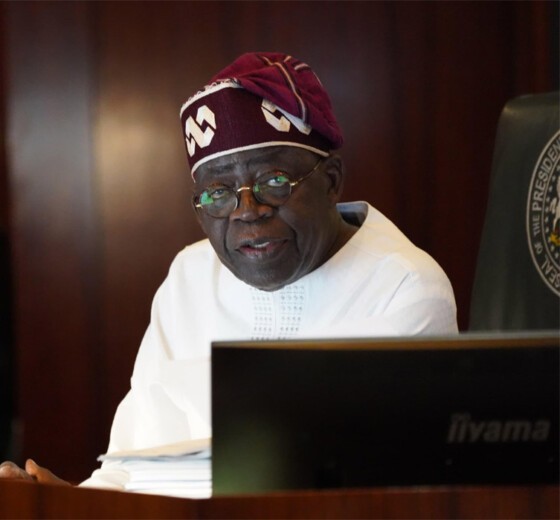

ABUJA — PRESIDENT Bola Tinubu on Tuesday told opposition elements and party faithful that “Elections are not conducted on social media platforms. Elections are conducted by Nigerians.”
The President also urged Secretary to the Government of the Federation (SGF) Senator George Akume to reconcile with Benue State Governor Rev. Fr. Hyacinth Alia for the unity of the state.
This is as President Tinubu has rallied governors, federal lawmakers and party leaders of the All Progressives Congress (APC) to consolidate economic reforms and intensify grassroots engagement, declaring that the administration is moving from economic stabilisation to full-scale growth acceleration in 2026.
Speaking through Vice President Kashim Shettima at the Progressive Governors Forum and Renewed Hope Ambassadors Strategic Summit, 2026, at the Presidential Villa’s Old Banquet Hall, Tinubu stressed APC unity as the party shifts from economic stabilization to growth.
He hailed Akume’s long service—from Benue’s director of protocol and permanent secretary, to two-term governor (1999-2007), senator, minister, and now SGF—before issuing a direct plea: “Let’s build the area together.”
The call drew applause amid tensions over Benue’s APC control.The rift pits Akume’s established machinery against Alia’s reformist base, which propelled his 2023 win amid insecurity and hardship.
Flashpoints include ward-level executives, nominations, parallel meetings, suspensions, appointments, and House of Assembly loyalties—threatening federal-state ties on security and development in the agrarian North-Central state.
Framing the administration’s first phase as one of “difficult but necessary corrections,” the President said structural reforms introduced since 2023 had begun to restore fiscal credibility and stabilise key macroeconomic indicators.
According to him, inflationary pressures are easing, fuel supply disruptions have been addressed and the naira is showing stronger fundamentals, aided by interventions of the Central Bank of Nigeria.
“Our economy is picking up. Major investment decisions across Africa increasingly favour Nigeria. That reflects renewed confidence in our direction,” he said.
Tinubu disclosed that the proposed N58.18 trillion 2026 budget would mark a pivot “from stabilisation to acceleration,” with record capital expenditure, the largest security allocation in the country’s history and tax reforms aimed at protecting vulnerable citizens while broadening the revenue base.
He stressed that policy success would ultimately depend on public understanding, charging members of the Renewed Hope Ambassadors platform to take reform messages beyond conference halls into wards, markets and campuses.
“This mission is about presence, truth and trust. Elections are conducted by Nigerians, not on social media platforms,” he said, urging party faithful to counter misinformation with verifiable facts.
The President commended Imo State Governor Hope Uzodimma, Director-General of the Renewed Hope Ambassadors, for coordinating what he described as a strategic mobilisation structure for civic engagement.
In a complementary presentation, Secretary to the Government of the Federation, George Akume, shifted attention from messaging to measurable delivery, urging governors to institutionalise Central Results Delivery and Coordination Units at the state level.
He said the Renewed Hope Agenda, built around priorities such as economic reform, security, food production, infrastructure and social investment, must evolve into what he termed a “culture of performance,” backed by digital dashboards and transparent scorecards accessible to citizens.
“Governance must move from policy pronouncements to measurable outcomes,” Akume said, emphasising stronger federal-state alignment as critical to sustaining reform momentum.
On the legislative front, Senate President Godswill Akpabio, represented by Speaker of the House of Representatives Tajudeen Abbas, reaffirmed the National Assembly’s backing for the administration’s reform architecture.
He described the fiscal consolidation measures, subsidy restructuring and tax reforms as foundational steps toward long-term prosperity, warning that policy gaps between government intent and public perception must be managed through transparency and sustained engagement.
Abbas proposed a quarterly reform interface between federal and APC-controlled state legislatures to harmonise laws and oversight priorities, alongside a “Renewed Hope Public Dashboard” to publish simplified data on revenues, capital projects and social interventions.
He also advocated structured youth and women participation in monitoring reform implementation, arguing that political ownership deepens when participation is genuine.
Across presentations, a common thread emerged: that reform credibility heading into 2027 will depend less on rhetoric and more on visible results, improved infrastructure, job creation, enhanced security and measurable economic stability.
The summit closed with a call for internal cohesion within the ruling party and sustained collaboration across tiers of government, as Tinubu reiterated that Nigeria’s long-term prosperity rests on disciplined leadership, coordinated delivery and national unity.
Tinubu’s intervention in Benue politics was aimed to healing fractures before opposition exploits them.
Observers see 2027 calculations fueling the feud, with party control key to future candidacies.
.